23 de agosto de 2006

Dark matter... finally an evidence! Or not?


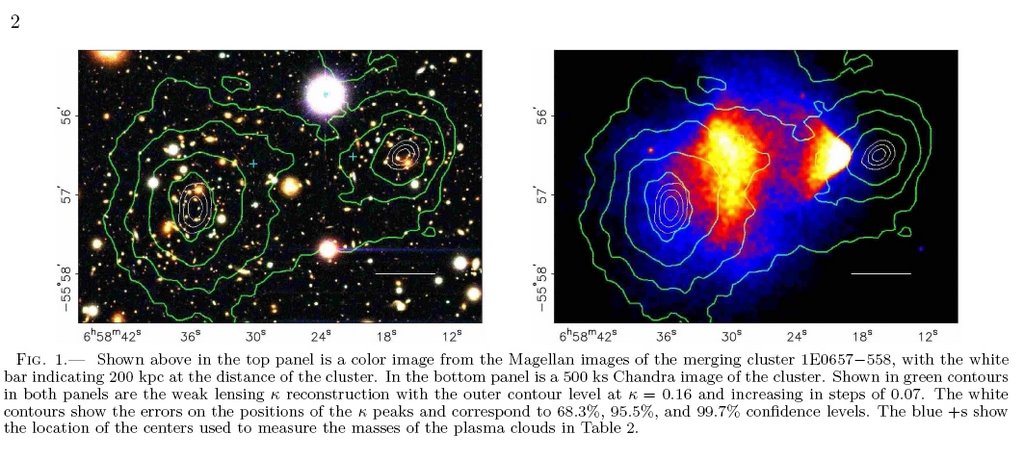
On August 21 there was an announcement regarding Dark Matter (DM) detection evidence from weak lensing observations of a known cluster merger (astro-ph/0608407). Douglas Clowe et al claim that the collision of two clusters, at z=0296, separates the dissipationless stellar and the X-ray emitting plasma components. The gravitational lensing maps shows clearly that the gravitational potential does not trace the plasma distribution, as can be seen from the picture. The X-ray images were made from Chandra data and the optical ones are a combination of VLT and HST/ACS in different bands (R, B, V).

What are the consequences of this claim? First of all, it is interesting to pay attention to the claim that the deformed structure detected does not depend on the (standard) cosmology adopted: Omega_M = 0.3, Omega_Lambda=0.7 and H0=70 km/s.Mpc. If the cosmology is changed, the distance and absolute masses will change, but not the observed structures, since the relative mass of the various structures do not change. The second claim is that the lensing cannot be explained by any alternative gravity model where the force scales with baryonic matter. In their words, "The lensing peaks require unseen matter concentrations that are more massive than and offset from the plasma."

So, what is measured is the spatial separation of baryonic matter from hypothesized DM during a cluster merger. Then, the hypothesis of DM is compared to visible matter+modified gravity (e.g., MOND), and the conclusion is that the observed displacement between the baryonic bulk and the gravitational well proves the presence of dark matter, under the assumption of "usual" gravity behavior.

For tomorrow, I'll comment the possibility of absence of cosmic acceleration (Middleditch, astro-ph/0608386) due to a flaw in the SN Ia explosion model paradigm (explosion of a degenerate core of a white dwarf under accretion of matter in a binary system).

I'll call for the day!

18 de agosto de 2006

What is a planet, after all?

It's been a few months since I posted, actually almost exactly 7 months... Let's see if I can keep it going now. Meanwhile, my science life has changed quite a while, with a much greater drive to astrobiology than for cosmology. And this, particularly the discussion about planets, is what brought me back.

You all may have heard that Pluto is risking to be disconsidered being a planet after the IAU Meeting that is taking place in Praga right now. In August 22 there will be a voting session, conducted by an IAU Commission, called the Planet Definition Committee, to decide, among other things, the statuts of Pluto as a planet, after the discovery of some other cousins with comparable dimensions and as large a period as Pluto.

Naturally, such discussions involve not only scientific but also social, historical and even philosophical aspects. For now, we accept the following criteria to define a planet:

  1. Planets must have masses above 5E20 kg
  2. Planets must have diameters above 800 km
  3. Planets must be spheroids (coming as a consequence of hidrostatic equilibrium in the presence of self-gravity)
  4. Planets orbit stars, being neither another star or a satellite of another object
What about binary or multiple planets and objects? Are they different from a planet and its satellites? If the primary (most massive) object satisfies the above criteria, it will be a planet. For the secondary or others, if the baricenter of the considered objects reside outside the primary, the secondary will be also considered as a planet and it will be a binary (or multiple) system. Otherwise, the secondary (less massive) will be a satellite.

We recognize now the eight classical planets, which move in almost circular orbits close to the ecliptic plane, and other planetary objects, such as asteroids, comets and the so-called TransNetunian Objects (TNO). From the above 4 definitions, the asteroid Ceres, for instance, can be considered a planet but, for historical reasons, it may be referred to as a "dwarf planet", to distinguish it from the classical ones. So, calling Ceres an asteroid is not technically correct any longer...

The TNOs are now being called "plutons" and include, besides Pluto and Charon, candidates such as Sedna, Quaoar, Orcus, Varuna, 2003 EL61 and 2003 UB313, all of them with dimensions similar (0.5 to 2 times) to Pluto, round and orbiting the Sun.

To close this post, all non-planet objects orbiting the Sun are now called "Small Solar System Bodies", as opposed to the old nomenclature: "Minor Planets".

Good to be back to this place.

19 de janeiro de 2006

Getting started in 2006

After 40 days away, here am I to restart the task of posting about my science life.

Good thing to get the year started: the paper on CMB angular correlations with Armando Bernui, Ivan Ferreira, Thyrso Villela and Rodrigo Leonardi was accepted after some time discussing with the referee. It will be published in March, as of my latest understanding. The editor said:

"Dear Dr Bernui,

We are very glad to inform you that your paper, "On the cosmic microwave background large-scale angular correlations", has been accepted for publication as a Research Note in Astronomy and Astrophysics, section 3. Cosmology (including clusters of galaxies). The official date of acceptance is 16/01/2006."

Goody! I will also close another paper on the Sunyaev Zeldovich effect with Raul Abramo and Laerte Sodre next week... it is the same subject I presented at the IAU Regional Meeting in Chile last month. We have to finish some calculations and give the paper a final form.... it's been 2 years and I got a ride on this one, because I was not part of it in the 1st submission. Then Raul asked me to help with some stuff and inivited me to be a co-author.

Well, regarding LARIM (the Chile IAU meeting), my opinion is that it was poorly organized, and will dedicate a sole poster to it tomorrow. Good to be back here.

10 de dezembro de 2005

Trip to Chile - 1) La Serena

Now... Saturday afternoon, after resting for more than 8 hours, I can post something more useful and make the scratch from last night turn into a poster.

I came to CTIO Headquarters on Friday afernoon and met Stephen Heathcote (big boss here) and Kepler Oliveira, a brazilian friend and a pretty good astronomer. I sat around, worked on my talk and stayed for a remote observation session at SOAR telescope last night. What a program!!! They were following the star HD221226, with three 20 min. exposure, then a calibration star was targeted and back to the same object again.

Then I left to work on my Monday morning talk on the SZ effect and, after 3h00 AM I went "home".

What is amazing about it? The most interesting thing is that, through a teleconference and 3 or 4 internet connections to SOAR, people at La Serena (CTIO Headquarters), Cerro Pachon (SOAR site) and University of Michigan could simultaneously follow - and even control - the observations. It was just not possible 5 years ago. Now, we can chat in real time and control the telescopes from the other side of the Earth!!!

Well, we still need the telescope operators for safety and fine tuning of the telescope parameters, but the science part can all be done remotely. As I was telling Alexandre Oliveira, a Brazilian resident astronomer at CTIO, "it is not robotic yet, but it is - quite sucessfully - really remote".

Now, you all have a good Saturday. I am finishing the details of my talk and tomorrow I will drive to Cerro Pachon and Cerro Tololo. Just wait great pictures soon.

Hasta la vista.

8 de dezembro de 2005

Leaving to Chile - 11th Regional IAU Meeting

Not much to post today. Finished my poster for IAU, discussed the closing of the topology paper with Armando Bernui... we keep on excusing ourselves along the whole text, saying that what we detect is not a foreground signal. It clearly comes from CMB but we do not dare to say that, UNTIL TODAY (so I hope). A couple more days and I expect to close this paper before the end of the year. You can check another "reading" of this topology approach through a paper of Armando Bernui on astro-ph/0511592.

Otherwise, paperwork, luggage preparation, writing last minute emails... one good thing is that in Chile I will have some spare time to work on the preparation of two other papers for early January 2006 (MNRAS with Ana Paula and Andre; ASTROBIOLOGY with Claudia, Amancio, Sergio and Heloisa). Great closing of 2005!

OK, I am departing to Guarulhos airport in about 1h for the 11th IAU Regional Meeting. Will try to keep you posted from there. There are some very promising talks scheduled during the meeting and I will also report my impressions from Cerro Tololo International Observatory and from my talk there.

See you Friday!

6 de dezembro de 2005

The I Brazilian Workshop on Astrobiology


For over 2 weeks I have been dealing with finishing two papers and organizing this Astrobiology workshop. The objective of the I Brazilian Workshop on Astrobiology (BWA) is to gather, for the first time in Brazil, professional scientists and graduate students from different fields that have been working or are interested in starting a career in one of the various topics related to Astrobiology, in a formal and academic environment.

The increasing number of papers in this area in the last few years is noticeable, coming mainly from Astronomy, Biology, Chemistry and Geology fields. Presently in Brazil there are astronomers searching for exoplanets, trying to understand the formation of planetary discs and, along with chemists, studying the chemistry of interstellar medium, particularly searching for organic compounds. Biologists have focused on extremophiles, studying their survival conditions and evolution in environements under extreme conditions (high temperature, pressure, salinity and pH). Geologists have worked in the investigation of atmospheric and geologic records of young Earth.

The I BWA is intended as an environment for scientists and graduate students interested in this multidisciplinary field to exchange ideas, results and perspectives for the development of the field in Brazil, with poster sessions, review talks and oral communications. The discussion sessions at the end of morning and afternoon talks will offer a good opportunity to exchange specific knowledge and expertise among the different fields represented in the workshop.

Go visit the web page!!!

Right now, finishing the IAU poster - "Can the Local Supercluster explain the low CMB multipoles?". The idea is that the low quadrupole observed in the CMB power spectrum since the COBE measurements, and confirmed by many other experiments in the late 90s and the WMAP data, might be due to the SZ effect in the direction of the Virgo cluster. The strong effect may remove the CMB photons from that area, distorting the low order multipoles and introducing an alignment mainly noted in the quadrupole and octupole.

We made a statistical test to verify if the alignment and the low intensity of the quadrupole could happen by chance. In short, the chance that this alignment is caused by a SZ intensity as we propose is larger than 1 sigma. On the other hand, the chance that the effect is purely caused by the CMB data as measured by WMAP is ruled out by over 2.5 sigma.

I gotta go back to finish the poster.

Soundtrack: Bluesology (Modern Jazz Quartet)

16 de novembro de 2005

Away for 5 days

In the last few days I was busy and yesterday it was a holiday in Brazil, so...

The DES (Dark Energy Survey) workshop happened on Nov 10-11 and I spent the day there on Friday. My talk was the 2nd on Friday morning, speaking about the SZ effect and observations that could be made comparing the DPOSS survey with WMAP data. I actually did not show much of what I've been doing with Reinaldo and Paulo, but could show the possibilities...

From Saturday to today I spent my time preparing the proposal to FINEP for the 1st Brazilian Workshop on Astrobiology... it's booming all over.... we have a good speaker coming from Imperial College (David Catling) and are trying another one, more biology-oriented.

So far, just paperwork and doing correlation analysis for the SZ paper to be presented at IAU in Pucon (December 12-16). UEEEEEEEEEEEBBBBBBBBAAAAAAAAA!!!!!!!!!!!!

Well, gotta go to the dentist.

9 de novembro de 2005

Weekly talk and point sources

Yesterday Simone Daflon, from Obs. Nacional, presented a talk on "Rotation and chemical abundances in B-stars". Nice talk, but too far away from my field. Later I started checking the point source distribution in the BEAST maps... terrible, I am pretty sure the numbers I got are wrong. Should check the galaxy cut and the RMS value.

The morning (yesterday and today) were spent doing stuff for the astrobiology workshop that will happen in March 20-21. Pretty good stuff, and the topics will be:

Exoplanets search
Habitable zones
Biomolecules in the ISM
Essential chemistry for life
Biogeochemistry and alternative chemistries for life

Now, back to BEAST point sources search.... 14h00 and couting.

8 de novembro de 2005

First post

Hello world! (Fortran standard for the first whatever you do in programming)

This is just to check if my first post is working.