Ontem estive na banca de mestrado de um aluno do IF/USP; Henrique Xavier. Ele falou da tomografia do Universo usando a Radiacao Cosmica de Fundo. Excelente trabalho, bem escrito, bem fundamentado, com todas as contas bem abertas, e com uma visao de aplicacao em cosmologia bastante interessantes.
O complicado dos resultados que ele apresenta e que os numeros nao sao la muito promissores se eles forem usar as medidas da RCF, ja que as amplitudes do que se espera nesse caso sao da ordem de 0,09 microK! Mas outras coisas podem ser feitas, buscando-se observar os efeitos em amplitudes maiores (da ordem de micro K).
Era isso ai... voltando para o efeito SZ!
Mostrando postagens com marcador cosmologia. Mostrar todas as postagens
Mostrando postagens com marcador cosmologia. Mostrar todas as postagens
27 de novembro de 2007


23 de agosto de 2006
Dark matter... finally an evidence! Or not?
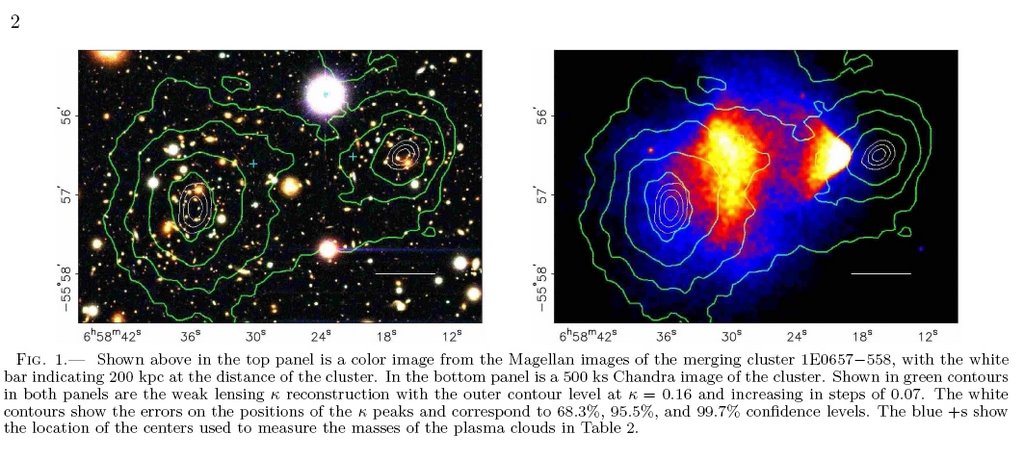
On August 21 there was an announcement regarding Dark Matter (DM) detection evidence from weak lensing observations of a known cluster merger (astro-ph/0608407). Douglas Clowe et al claim that the collision of two clusters, at z=0296, separates the dissipationless stellar and the X-ray emitting plasma components. The gravitational lensing maps shows clearly that the gravitational potential does not trace the plasma distribution, as can be seen from the picture. The X-ray images were made from Chandra data and the optical ones are a combination of VLT and HST/ACS in different bands (R, B, V).
What are the consequences of this claim? First of all, it is interesting to pay attention to the claim that the deformed structure detected does not depend on the (standard) cosmology adopted: Omega_M = 0.3, Omega_Lambda=0.7 and H0=70 km/s.Mpc. If the cosmology is changed, the distance and absolute masses will change, but not the observed structures, since the relative mass of the various structures do not change. The second claim is that the lensing cannot be explained by any alternative gravity model where the force scales with baryonic matter. In their words, "The lensing peaks require unseen matter concentrations that are more massive than and offset from the plasma."
So, what is measured is the spatial separation of baryonic matter from hypothesized DM during a cluster merger. Then, the hypothesis of DM is compared to visible matter+modified gravity (e.g., MOND), and the conclusion is that the observed displacement between the baryonic bulk and the gravitational well proves the presence of dark matter, under the assumption of "usual" gravity behavior.
For tomorrow, I'll comment the possibility of absence of cosmic acceleration (Middleditch, astro-ph/0608386) due to a flaw in the SN Ia explosion model paradigm (explosion of a degenerate core of a white dwarf under accretion of matter in a binary system).
I'll call for the day!
Assinar:
Postagens (Atom)